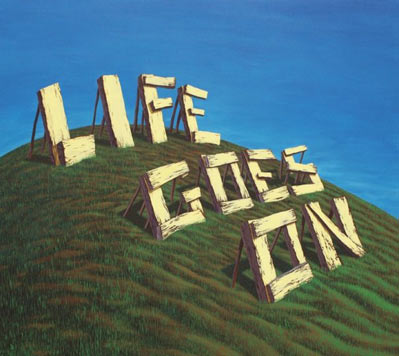
Saya sedang di Kupang, NTT waktu itu merayakan natal dan tahun baru bersama keluarga besar. Waktu itu seorang pemuda harus diamputasi tangannya karena kecelakaaan kembang api. Tapi setelah itu apa lagi yang kita tahu mengenai pemuda itu? Nyatanya hidup tetap berlanjut, kembang api lagi, 2009 ke 2010, tertawa lagi, sedih lagi... Semua tetap akan berlanjut... :D
Selamat Membaca :D
Out, Out by Robert Frost is based on and comparable to Shakespeare’s Macbeth, Out, out, brief candle. And also something interesting that the poem is also might be based on a true event happened in 1915 about Raymond Fitzgerald, the son of Frost’s friend and neighbor. Like any other of Frost’s works, this poem showcases beautiful scenery and in the poem, the persona beside is in an adoration of the scenery, he/she also is in an observation of a boy working with his buzz-saw snarled. The persona depicts the life of the boy which is too short and snatched away from him in a wink of eyes.
Overall, despite the dark characteristics of this poem, I love the simplicity of this the most, no stanzas but a long narrative poem consist of a single verse paragraph and without formal divisions. Syntactically and semantically, I can follow the story of this poem not just like the other poems from the ancient England or maybe from the era when language was something rare for human which are so complicated in vocabularies and grammar.
In the 1st to the 3rd sentence Frost tried to picture a situation of a yard where someone is sawing wood. In the yard where the buzzing saw snarled and all eyes can see and count the five mountain ranges under the beautiful twilight into Vermont (line 4-5). The poem itself suggests that everything is so calm; we can smell the sweet-scented wood, the scenery is so delightful except for the annoying saw but why the boy is working alone instead of sitting admiring the scenery together with his really friends? Well this is what I would do if I were the boy. And yes he supposed to be in school; maybe the family is in a financial crisis so the boy also takes the responsibility to work (line 24) “Doing a man’s work though a child at heart.”
Frost is known for using and exploring such pastoral scenes and the relationship between nature and human beings, those sceneries are drawn to be so emotional and alive. The range of mountain and sunset- Vermont’s mountain range is so famous- but five? Vermont’s Green Mountains actually consists of several more than five mountains but yes the peaks are five; also sunset has a close relation with something which is almost done or finished. It is like we can see the peaks of our life when it almost comes to the end. The peaks’ shadows are slowly moving. Just like the quote from the end of Shakespeare’s Macbeth:
Out, out, brief candle!
Life's but a walking shadow, a poor player,
That struts and frets his hour upon the stage,
And then is heard no more. (V.v, lines 23 – 26)
“Life’s but a walking shadow”. The sun begins to disappear as the peaks’ shadows seem to be walking. But the boy, he is just a boy.
It seems like a busy family, the boy is sawing and the sister is cooking. In the 10 monosyllable line, there is a conversational language (‘Call it a day, I wish they might have said’), this line is very argumentative in contrast to the rest of the poem, and also I wish they would give the boy the half hour that he would count so much before continuing his job or having supper, I wish if he would be given the chance that he would count so much to continue his life.
In line 13, the sister comes surprising him then he lost his concentration. To picture the losing concentration of the boy, Frost used the saw then personified it clearly yet vividly like it is an antagonist person in this poem (‘As if to prove saws knew what supper meant’) in line 15. He had his hand sawed himself, in line 23 he had seen everything though he is just a boy but I believe he doesn’t see the peaks of his life not yet, he doesn’t want to see them. He just slightly encounters with something called fear, fear of death or the death itself. But in line 21, he keeps holding up his hand, he doesn’t want to lose it. He doesn’t want to lose his life, his status as one of the family’s backbones, what would be his role in society if he lost the hands, line 25 “Don’t let him cut my hand off…” Yes, he doesn’t want to be “a poor player that struts and frets his hour upon the stage and then is heard no more.” Considering the last two lines, he still wants to build on something with his hands he wants to be remembered and to be honored when the time he has already seen the real peaks of his life that also can be seen by everybody just like the peaks of Vermont Mountains by the time he almost finished his time. Huh if just he was given the half hour that he could count so much continuing his life to reach the peaks. Line 27, but the hand is gone already and he is just a boy, his life is certainly short, brief, meaningless, signifying nothing. Frost shows an awareness that all life is brief and that it either fades or ends abruptly. Life dies. He recognizes that he too will die. His poetry shows that he, like many people, has a desire to fill his days with as much productive living as possible before that time comes. Frost also portrayed the solidarity of human being, human loneliness and alienation. Last lines, and they people turn to they affair then life goes on. Really a tale told by an idiot, full of sound and fury, signifying nothing.
I am now spending my year-end in my home town. View days ago, I heard that there was a fireworks accident. A boy had his hands amputated because of the accident. Photos and videos of him were all around, and people, we were like shocked and there were no fireworks for some days. Parents forbid their children playing fireworks; people really felt the traumatic experience. But when the New Year’s eve, I could see fireworks in the entire Kupang city’s sky, and the boy? We really forgot even the name of his, now there is no ‘has his hus …’ about him. Even Frost sometimes believed that human solidarity really existed; he often emphasized human loneliness and alienation. Frost believes (so do I) that despite our separation as individuals, humans are social beings.